Ascension Sunday and St. Louise de Marillac
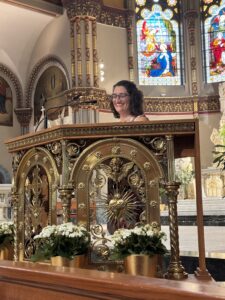
Delivered at 5:00pm mass at St. Vincent de Paul parish, May 17, 2026
—————————————-
My child’s first and middle names are Leila Louise. Leila, in Arabic, means both night and beauty. Louise is to honor the courage, compassion, and innovation of Louise de Marillac. When I speak with Leila about their name, we often talk about how Leila reminds us that beauty and hope are everywhere, even in the darkness when they are difficult to see, and Louise reminds us to put love into the world.
When Rachelle asked me to join you this evening and reflect on Ascension Sunday and Louise, I thought of my child’s names. Leila, night beauty, for the ascension. Louise for, well, Louise.
Let’s start with the ascension- night beauty.
I’ve been thinking a lot about empire lately. Particularly, about how it is impossible to understand Christianity apart from empirical governance. Mary labored to give birth to Jesus while seeking refuge from the decrees of a Roman-appointed king. Let’s pause and think about that for a moment. Imagine with me a map of the world. Bethlehem sits in the modern day Palestinian West Bank. To travel from Bethlehem to Rome, one would have to journey north through Lebanon and Syria, east through Turkey, Macedonia, and Albania, across the Adriatic Sea and finally from Italy’s far-west to far-east shore.
When we say that Jesus lived his life under the occupation of the Roman Empire, what we mean is that an authority from over 2,000 miles away dictated his day-to-day life. This would have impacted his freedom of movement, his freedom of self expression, the taxes that he paid. It would have pitted his religious laws against the nation’s laws.
This context matters.
It matters because when we see armed immigration agents on our streets making our communities vulnerable or unjust wars being waged under false pretenses or voting rights being stripped from our neighbors, we have a guidebook, a place to turn for wisdom, a reminder from the gospel this evening, “Behold, I am with you always until the end of the age.”
Jesus’ invitation to his disciples at the time of the ascension was to, “Go, therefore, and make disciples of all the nations…teaching them to observe all that I have commanded you.” What was it exactly that the disciples were meant to teach? What does ascension mean for an occupied people?
In Luke chapter 4, we learn that the first time that Jesus taught publicly during his ministry, he read from the scroll of Isaiah, “The Spirit of God is upon me, because God has anointed me to bring glad tidings to the poor. God has sent me to proclaim liberty to captives and recovery of sight to the blind, to let the oppressed go free, and to proclaim a year acceptable to God.” After reading this scroll, Jesus said, “Today this scripture passage is fulfilled in your hearing.”
Jesus lived through occupation and taught those around him to lift up service above power, compassion and care above dominance. His legacy was not one of wealth but instead one of community care. He taught us how to be in relationship with one another, even in the most uncertain times.
In today’s second reading, we hear that God has placed the ascended Jesus “far above every principality, authority, power, and dominion, and every name that is named, not only in this age but also in the one to come.” What I hear in this is that the servant outlives the empire. Over and over again, for all the ages to come, the servant outlives the empire.
Night beauty.
In my musings on empire, I often ask myself, “Whose are the voices that empire withholds from the narrative?” In the first reading from Acts, two figures appear to the disciples after Jesus ascends and say, “Men of Galilee, why are you standing there looking at the sky?” To which, I immediately pondered, “And what about the women?” Where were the women of Galilee while the men of Galilee stared into the sky?
Knowing what we know about the women who followed Jesus–the ones who stayed until his last breath and took fresh wrappings to his tomb and first discovered the resurrection–I’m going to guess their hands were already busy and calloused with the work of Jesus’ legacy. They were midwives- lending their shoulders to their sisters who labored, healers- grinding herbs into medicines and salves, prophets- proclaiming the good news before the disciples believed it was possible, innovators, deaconesses, and on and on and on.
And that brings us to Louise.
Louise also lived in a time of cultural upheaval. Born in 16th century France, Louise would have been surrounded by a profound wealth gap, high society families living much differently than the peasants who tended their land. Louise walked with one foot in each world. Born to a wealthy aristocrat father, she grew up learning the lessons and etiquette of society. As she never knew who her mother was, she was considered an outcast and was not guaranteed the comfort and stability of the rest of her family.
During Louise’s time, a woman only had two options for her life: get married or take religious vows and live behind closed walls.
Louise changed all of that.
At the age of 20, Louise wished to join a religious order. The director refused her saying, “God has other plans for you.” She instead entered into an arranged marriage and became a mother before her husband grew chronically ill and died, leaving Louise a widow at an early age. It was then, struggling with anxiety and in search of spiritual guidance, when she met Vincent de Paul. Together, after a brief period of getting on each other’s nerves, they looked around at an aching world and put plans in motion. As Vincent founded the Vincentian priests, Louise began forming the Daughters of Charity, a group of religious women committed to serving the “poorest of the poor.” Rather than staying behind cloistered walls, the Daughters of Charity fed those who were hungry, cared for orphaned children, healed those who were sick.
It is said that if the Daughters were at daily mass and a neighbor knocked on their door, their approach was to stand up from their pew, walk to the door, and help them. Vincent once called it, “Leaving God for God.”
Louise was resilient and inventive. She took the lessons she learned from the hardships in her life and used them to build something extraordinary. From her time in high society, she knew how to pen appeal letters with impeccable penmanship. From her time shunned from high society, she knew how to get her hands dirty and do the hard work that needed to be done. She recruited women who were not yet literate, taught them to read and write, and brought them into the community to serve others.
In a letter to Louise, Vincent once noted how the city streets were her cloister. Considered the pioneer of social work, Louise opened the world for women and provided them a third option for their lives, one that lived and breathed in the world.
Today, more than 13,000 Daughters of Charity live and serve in nearly 100 countries. I have had the immense privilege of encountering their work across this country and in four others. In every place I have met the Daughters, they have taught me how to serve with joy, conviction, and creativity. They hold dignity at the center, always, and they laugh with enough fervor to sew a stitch in your gut. They get the work done.
Louise’s legacy–the daughters who followed her footsteps and the lay women whose lives she has inspired–is a profound example of the ascension call to go out into the world, to love largely, and to find beauty in the night.
I wish to leave you with a blessing from a book that was published last year titled Liturgies for Resisting Empire, written by Kat Armas.
“God Who Dwells on the Margins, where power does not dare to look, we call upon you, the sacred who lives in whispers and shadows–in the quiet, where words are not rushed, where power has no place to hide. Let us be grounded in your mystery, for you are more than nation, more than law or hierarchy. You are the hidden strength in the fragile and the small. We call upon you, Spirit of the oppressed and silenced, help us to let go of all the small tyrannies within: the worry, the fear, the need for control. Here, we choose to resist the powers that would divide us, exploit us, or convince us to believe in our own isolation. May we find courage in your presence, and may we resist the voices that seek to dominate our souls.”